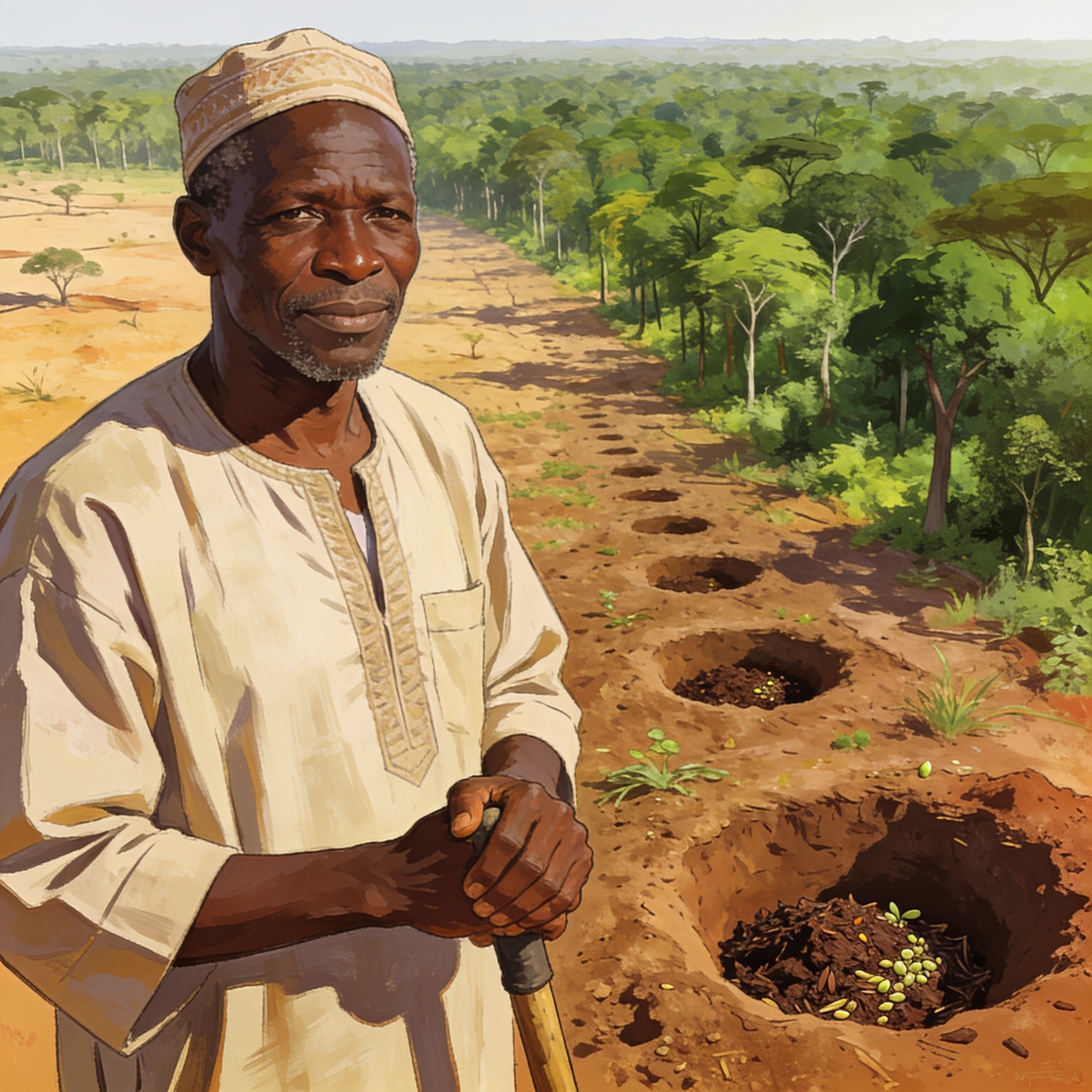
In the early 1980s, Yacouba Sawadogo began digging pits in the dry soil of northern Burkina Faso. The region faced severe drought and land degradation that threatened local livelihoods. Sawadogo adapted a traditional farming practice known as zaï to address these challenges.
How the Method Works
The zaï technique concentrates rainwater in small pits so it reaches plant roots directly. Each pit receives natural compost or fertilizer, and seeds are planted when rain arrives. Sawadogo made three key adaptations to improve the traditional method. He used wider and deeper pits reinforced with stones to hold water. He relied on termites to break up hardened soil and create paths for roots. He prepared the ground well before the rainy season, unlike neighbors who waited.
Results of the Restoration Effort
Four decades after starting, Sawadogo had transformed 40 hectares of arid land into a forest containing more than 60 species of trees and shrubs. According to the United Nations Environment Programme, crop productivity increased by 100% to 500% using this method. Approximately 95% of farmers in his region adopted the technique. The approach spread across 6,000 kilometers of Africa, appearing in Sahel countries, Ghana, Chad, and Kenya.
Recognition and Legacy
Sawadogo received the Champions of the Earth prize in 2020 in the Inspiration and Action category, the highest environmental honor from the UN. He died in December 2023 at age 77. His work became part of the Great Green Wall initiative, an African effort against land degradation and desertification. Local knowledge, patience, and persistence enabled him to recover land many considered lost.
What it means
This case demonstrates how simple, labor-intensive methods can reverse desertification without expensive technology. Farmers facing similar conditions in arid regions could potentially apply the same principles to improve yields and restore soil health. The widespread adoption in parts of Africa suggests the approach has practical value beyond individual farms.
Uncertainty remains about whether the method works equally well in all soil types and climate conditions. Long-term sustainability depends on continued community participation and access to training. The success story does not guarantee immediate results for every location attempting the technique.
Do you know of any low-cost agricultural methods that have successfully restored degraded land in your area? Share your experience in the comments.