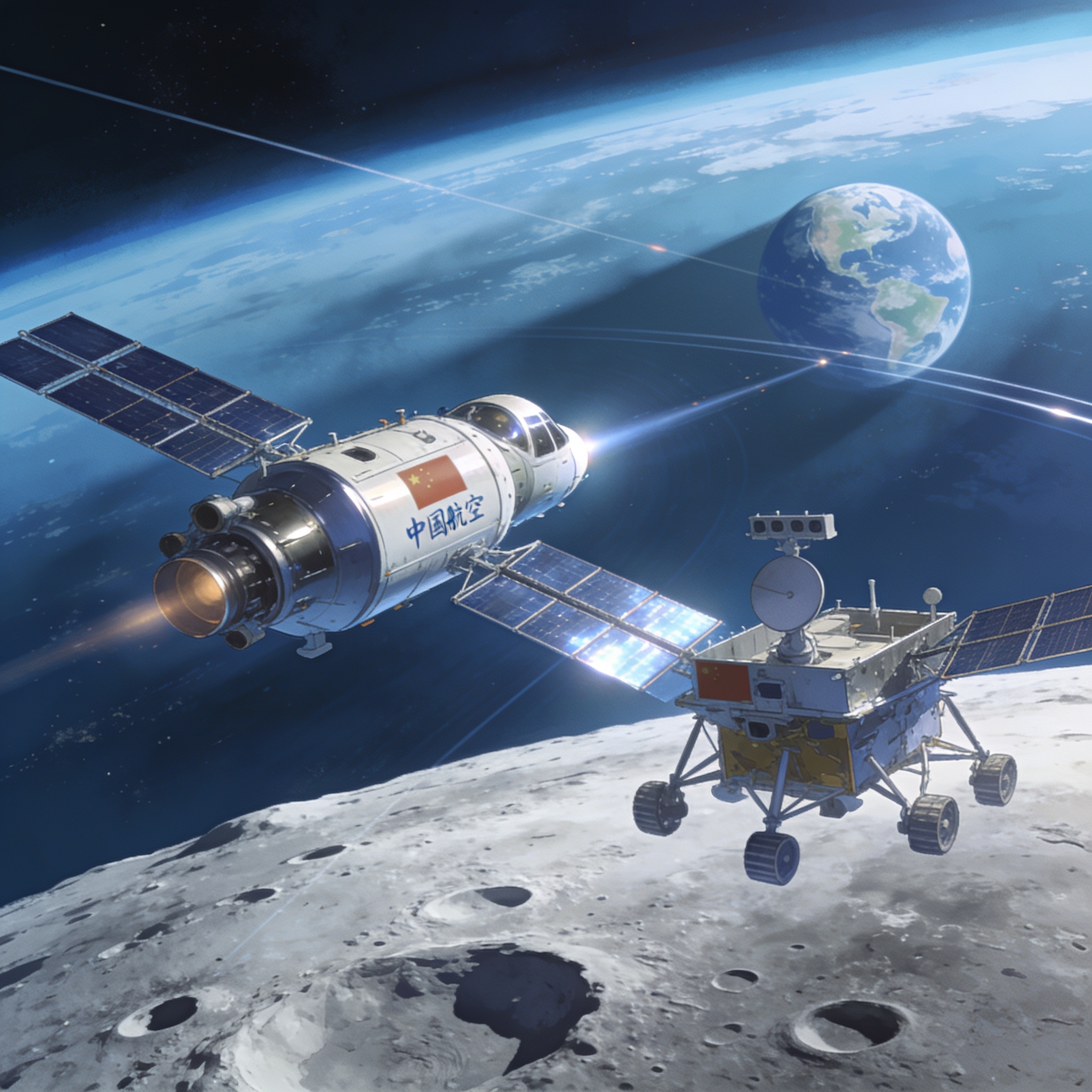
China has outlined new details of its plan to conduct a crewed mission to the Moon before 2030. The strategy centers on two separate launches, an orbital rendezvous in lunar orbit, and a three-person crew, two of whom will descend to the Moon.
During the 7th Symposium on Manned Spaceflight, Wang Xiang, deputy chief designer of China’s crewed space program, described the architecture. Two Long March 10 rockets would be used: one to ferry the crewed spacecraft Mengzhou to lunar transfer orbit, and another to carry the lunar lander/surface module Lanyue. After reaching the Moon’s vicinity, the two vehicles would rendezvous and dock. The crew would transfer from Mengzhou to Lanyue, which would descend to the lunar surface, while one astronaut remains aboard Mengzhou to serve as transport and return vehicle.
The plan resembles NASA’s Apollo-era approach, where a lunar module separated from the main spacecraft to land and then returned to lunar orbit for the ascent/descent sequence. The mission’s three core components are the Long March 10 rocket, the Mengzhou crewed spacecraft, and the Lanyue lunar lander. Mengzhou would bring astronauts to lunar orbit and later return them to Earth; Lanyue would carry two crew members to the surface and back to orbit.
Key milestones outlined include: early 2027 — uncrewed Long March 10A launches Mengzhou for low Earth orbit tests; 2028 — uncrewed lunar-configuration test of Long March 10 with Lanyue, including descent and ascent demonstrations; 2029 — two uncrewed spacecraft (Mengzhou and Lanyue) to test rendezvous and docking in lunar orbit; before 2030 — crewed mission with two astronauts descending to the Moon.
Officials note these dates reflect planning and are not guarantees of execution. Preparatory steps have already included Mengzhou escape system tests, Lanyue landing/takeoff demonstrations, and a low-altitude test of Long March 10. The plan also envisions using China’s Tiangong space station in low Earth orbit to validate technologies before lunar deployment.
China’s Moon mission aims sit within a broader competition with the United States, which also plans crewed lunar missions. The Chinese program contemplates a longer-term international collaboration and the construction of a Lunar Research Station, with initial construction slated for 2031 and powered by the later high-performance Long March 9 rocket. The immediate priority remains proving that all mission components can operate in concert, including the rendezvous, lunar descent, and ascent back to orbit.
Sources emphasize that the timeline is a planning reference and not a guaranteed sequence of events.